

Disclosure: As an Amazon Associate, I earn from qualifying purchases. This post contains affiliate links, meaning I may receive a commission if you click through and buy, at no extra cost to you. #ad
Apple is Known For its Innovation and Apple has never been afraid to challenge industry norms. From removing the headphone jack to pushing eSIM adoption, the company has consistently redefined smartphone standards. With the launch of the iPhone Air, Apple once again disrupts expectations — but this time, the move feels more radical.
An ultra-thin body, no physical SIM slot, a single rear camera, and the powerful A19 Pro chip — the iPhone Air represents a dramatic shift in Apple’s design philosophy.
But the real question is:
Is the iPhone Air genuine innovation, or is Apple asking users to pay more for less?
After analysing its design, performance benchmarks, camera capabilities, and real-world usability, here is a comprehensive breakdown.
Read also – iPhone 17 Pro Max review
Checkout for iPhone Air Price
iPhone Air Review Bench Marks
Pros-
- In Hand Feeling
- Slim Design actually good in Use
- Main Camera Performance
- Real World Performance
Cons-
- No telephoto lens , No Ultrawide Camera
- No Physical Sim Slot ( its very Frustrate to change Sim )
- Battery Backup
Design & Build: Engineering Minimalism (iPhone Air Review)

When you take this Phone In your Hand ,The first thing you notice—and the only thing you’ll talk about for the first hour—is the thickness. At 5.6mm, the iPhone Air is significantly thinner than the iPhone 6 (6.9mm) and nearly 30% thinner than the iPhone 17 Pro.
Apple achieved this through a new internal plateau architecture. By mounting the logic board and the A19 Pro chip behind a raised camera “island,” they freed up the rest of the body for a high-density battery.
- Weight: 165 grams (making it the lightest flagship in years).
- Durability: Despite the slimness, the Grade 5 Titanium frame ensures it doesn’t flex. Apple’s “Bendgate” days seem firmly in the past.
No SIM Slot: The Wireless Future or a Forced Transition?(iPhone Air Review)

I Literally saw 3 times to find the sim slot , The iPhone Air eliminates the physical SIM tray entirely and operates solely on eSIM technology.Apple’s reasoning is clear:
- More internal space for structural components
- Better water and dust resistance
- Simplified internal architecture
- Push toward a fully wireless ecosystem
From a future-focused perspective, this move makes sense.
However, adoption varies globally.
In markets like India, where users frequently swap SIM cards or use multiple carriers, this change could create friction. Travelers may also face activation challenges in regions where eSIM support is limited.
That said, the global telecom industry is moving toward digital SIM provisioning. In a few years, this transition may feel natural.
Innovation? Yes.
User-friendly today? Depends on your region.
The Single Camera: A Step Backward?
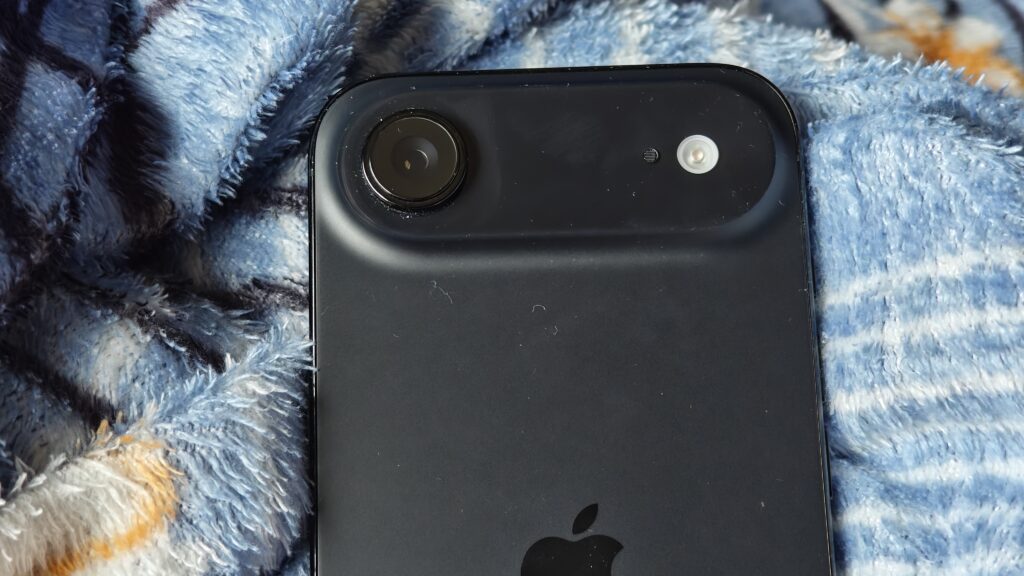
Apple iPhone is Known for Its camera performance and after iPhone 17 Pro Max Benchmark camera , Apple gives only single camera in this Air and ,Perhaps the most controversial decision is the single rear camera system.
At a time when competitors push triple and quad-lens setups, Apple takes a minimalist route.
But Apple isn’t relying on hardware quantity — it’s relying on computational photography.
Camera Specifications Overview
- Single 48 MP Pro motion high-resolution wide sensor
- Advanced image signal processing
- AI-enhanced HDR
- Night mode with improved light capture


Don’t let the single lens fool you. This is the most advanced 48MP sensor Apple has ever made.
- 2x Optical-Quality Zoom: By cropping into the center of the sensor, Apple provides a 12MP “optical” zoom that is sharp and vibrant.
- Center Stage: The 18MP front camera is also upgraded, ensuring you are always in frame during FaceTime calls.
Video Performance
Video remains Apple’s kingdom. The iPhone Air supports 4K60 Dolby Vision and features a new “Action Mode” that is surprisingly stable despite the lack of dedicated telephoto hardware.
Expert Note: While the video quality is Pro-grade, the lack of an Ultra-Wide lens means you lose that “cinematic” 0.5x field of view. For creators, this might be the deal-breaker.
A19 Pro Chip: The Real Star of the Show
When I Use This Smartphone and I Shocked because, The most powerful component inside the iPhone Air is the A19 Pro chip.
Apple’s silicon advantage remains unmatched in mobile performance efficiency.
Performance Highlights
- Faster CPU architecture
- Enhanced GPU rendering capabilities
- Improved AI engine performance
- Better thermal efficiency
Real-World Testing Experience
In daily use:
- Apps launch instantly
- Multitasking is seamless
- High-end gaming runs smoothly
- 4K video editing is responsive
What stands out is efficiency. Despite a thinner body and smaller battery capacity, the A19 Pro optimizes power consumption intelligently.
Battery Life: The Cost of Thinness
I think you all have a question about that how is Battery life of iPhone Air and Ultra-thin design inevitably impacts battery size.
While the A19 Pro chip improves efficiency, heavy users may notice:
- Faster drain during gaming
- Reduced endurance compared to Pro Max models
- Possible need for evening charging
Moderate users can still comfortably complete a day.
If battery longevity is your highest priority, larger iPhone models remain better options.
The iPhone Air prioritizes portability over endurance.
User Experience: Who Is This Phone Really For?

Honestly i says that this phone give some fresh experience to me and The iPhone Air is not trying to compete with the most feature-packed smartphones.
Instead, it appeals to a specific user mindset.
Ideal For:
- Professionals wanting lightweight elegance
- Users who value design over hardware count
- Everyday consumers prioritizing performance
- Minimalists who prefer simplicity
Not Ideal For:
- Mobile photographers needing lens flexibility
- Heavy gamers demanding long battery life
- Frequent SIM switchers
- Users who prefer hardware-rich devices
Apple is targeting a refined audience — not power maximalists.
Is the iPhone Air Overhyped?
Let’s break it down objectively.
Arguments for Innovation:
- Industry-leading thin design
- Full eSIM implementation
- High-performance A19 Pro chip
- Strong video capabilities
- Refined build quality
Arguments for Overhype:
- Single camera limits flexibility
- Battery compromises
- Premium pricing
- Reduced hardware compared to competitors
The iPhone Air is innovative in engineering and design philosophy.
However, for users expecting maximum hardware features at premium pricing, it may feel underwhelming.
It’s a bold experiment — and like all bold experiments, it will divide opinion.
Conclusion
The iPhone Air signals a shift in Apple’s priorities.
It shows confidence in software optimization over hardware expansion. It pushes users toward a wireless future. It challenges the idea that “more cameras equals better phone.”
Is it innovation? Absolutely.
Is it for everyone? No.
The iPhone Air isn’t just another smartphone — it’s Apple testing how minimal a flagship can become while still feeling premium.
And that’s what makes it one of the most interesting releases in recent years.
FAQ (Frequently Asked Questions)
1. Is the iPhone Air worth buying in 2026?
The iPhone Air is worth buying if you prioritize ultra-thin design, lightweight build, and powerful performance with the A19 Pro chip. However, if you need multiple camera lenses or long battery life, other iPhone models may offer better value.
2. Does the iPhone Air have a SIM slot?
No, the iPhone Air does not include a physical SIM slot. It is fully eSIM-based. Users must activate their carrier digitally. This may be convenient in developed markets but could be limiting in regions where eSIM adoption is still growing.
3. How good is the iPhone Air camera with only one lens?
Despite having a single rear camera, the iPhone Air delivers strong photo quality thanks to advanced computational photography and AI processing. Daylight shots are sharp and color-accurate, while night performance is solid. However, it lacks optical zoom and ultra-wide flexibility.
4. Is the iPhone Air better than the Pro model?
The iPhone Air focuses on thin design and portability, while Pro models emphasize hardware features like multiple cameras and larger batteries. Performance-wise, both are powerful, but Pro models may offer more versatility for power users and photographers.
5. How powerful is the A19 Pro chip in the iPhone Air?
The A19 Pro chip delivers flagship-level performance. It supports smooth multitasking, high-end gaming, 4K video editing, and advanced AI features. It is designed for efficiency, making it ideal for users who want speed without compromise.
6. Does the iPhone Air have good battery life?
Battery life is decent but not class-leading. Due to its ultra-thin design, battery capacity is slightly smaller compared to larger iPhone models. Moderate users can expect a full day, but heavy gamers or video editors may need evening charging.
7. Is the iPhone Air good for video recording?
Yes, the iPhone Air offers excellent video recording performance. It supports 4K recording with strong stabilization, accurate colors, and smooth autofocus tracking. Even with a single lens, video quality remains one of its strongest features.
8. Why did Apple remove multiple cameras in the iPhone Air?
Apple likely prioritized thinness and internal space efficiency. Instead of adding more lenses, it focuses on AI-driven image processing. The goal appears to be simplicity and design elegance rather than hardware quantity.
9. Is the iPhone Air future-proof?
With the A19 Pro chip and full eSIM adoption, the iPhone Air is built with a forward-looking approach. It supports advanced AI features and long-term software updates, making it a future-ready device in terms of performance and ecosystem integration.
10. Who should avoid buying the iPhone Air?
Users who:
- Frequently switch SIM cards
- Need optical zoom photography
- Require long battery endurance
- Prefer hardware-rich flagship phones
may find other iPhone models more suitable.
for more articles please visit www.techdrivehub.com and subscribe our youtube channel thetechdrivehub for videos